
News
2026 Top Programmable V Cut Grooving Machine for Grey Board?
A Programmable V Cut Grooving Machine For Grey Board can turn flat sheets into crisp, repeatable folds for rigid boxes, book covers, and display packaging. Yet a clean V-groove is not just a matter of machine speed. Board thickness, grain direction, blade condition, feed alignment, and groove depth all affect the finished edge. A shallow cut may resist folding; a deep one can weaken the board or expose its liner. Small details matter.
Industry reports provide useful context, but not a shortcut to machine selection. Smithers’ The Future of Paper-based Packaging to 2028 examines changing demand and material use across paper-based packaging. Its market-level perspective should not be mistaken for a performance test of any individual grooving machine. Buyers still need to verify practical measures: setup time, repeatability across a production run, scrap rate, supported board thickness, and the effort required to change jobs. Bring sample grey board. Check the fold under real lighting. Then inspect the reverse side.
Quality-management expert W. Edwards Deming is commonly credited with the line, “In God we trust; all others must bring data.” It is a useful reminder here—not a machine-specific claim. Ask suppliers for documented trials on comparable board, and record the settings that produced each result. A neat sample is encouraging. It is not proof of consistent output. Even a programmable system needs sensible calibration, operator checks, and room for imperfect material. That is the detail buyers should keep in view when comparing 2026 models.
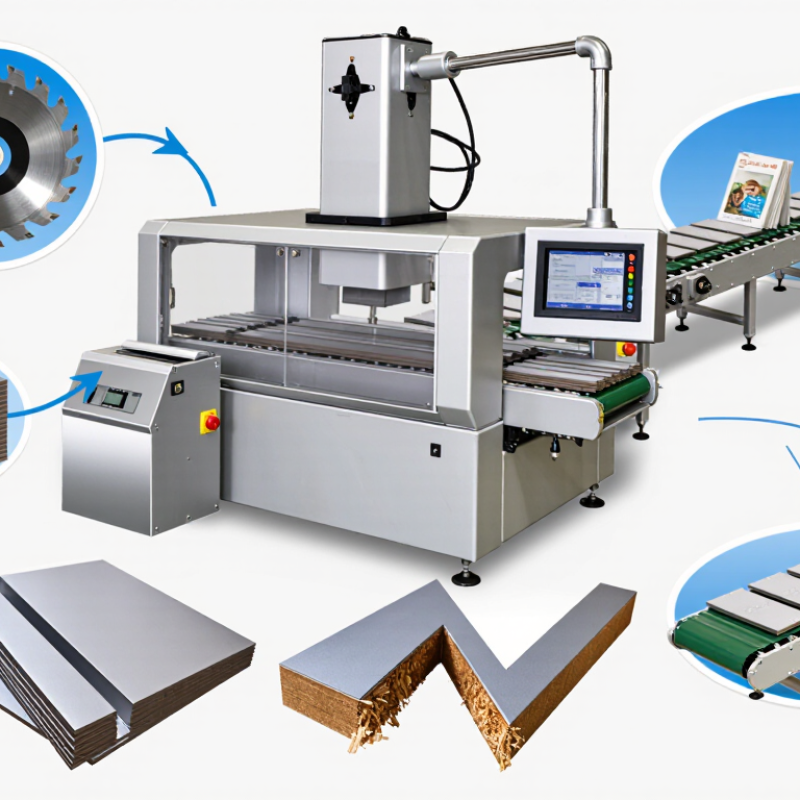
Grey Board Basics: Typical 0.5–4 mm Caliper and Fibre-Direction Effects
Grey board commonly ranges from 0.5 to 4 mm thick, but equal caliper does not guarantee equal cutting behavior. Measure each batch rather than relying on a supplier’s nominal figure. TAPPI T 411 provides a standard method for measuring paper and paperboard thickness. For a programmable V-cut grooving machine, thicker stock may need a deeper groove, while thin board can split if the blade enters too far. Check the cut on a real sheet.
Fibre direction matters. During papermaking, fibres tend to align more strongly in the machine direction, so stiffness and tensile response can differ across and along the sheet. ISO 1924-2 specifies a tensile-testing method for paper and board; it does not set one universal machine-direction-to-cross-direction ratio. Recycled furnish, moisture, and pressing all affect results. Aligning the groove with the grain may help reduce cracking, but test both orientations—the outcome can be less predictable than expected.
Tips: Mark the machine direction on a sample, then cut short test grooves at the intended depth. Inspect the edges under good light. Fraying or a lifted surface layer signals that the setting needs adjustment.
2026 Top Programmable V Cut Grooving Machine for Grey Board? - Grey Board Basics: Typical 0.5–4 mm Caliper and Fibre-Direction Effects
Grey board commonly used for rigid packaging and bookbinding is available in calipers around 0.5–4 mm. The settings below are practical starting points for trials, not universal machine specifications; board density, moisture, blade geometry and machine condition affect results.
| Grey Board Caliper | Suggested Starting Residual Web | Approximate Groove Depth | Typical V-Groove Angle | Fibre-Direction Consideration | Trial Check |
|---|---|---|---|---|---|
| 0.5–1.0 mm | About 0.15–0.25 mm | About 0.25–0.85 mm | 90° is a common starting point | Thin board is sensitive to tearing and cracking. Test grooves both parallel and perpendicular to the machine direction. | Check for cut-through, edge fuzz and a clean fold before running a full sheet. |
| 1.0–2.0 mm | About 0.20–0.35 mm | About 0.65–1.80 mm | 90°; adjust to the required fold geometry | Folding across the dominant fibre direction may require a different depth or web than folding along it. Confirm with a physical fold test. | Inspect the outer face for whitening or cracking and the groove for an even base. |
| 2.0–3.0 mm | About 0.25–0.40 mm | About 1.60–2.75 mm | 90° for many right-angle folds; verify the finished corner | Fibre orientation and board layering can influence fold resistance and spring-back. Keep orientation consistent when comparing samples. | Check fold angle, corner closure and remaining web along the entire groove. |
| 3.0–4.0 mm | About 0.30–0.50 mm | About 2.50–3.70 mm | Select to suit the fold design and board construction | Thicker board may show greater variation across the sheet. Test both fibre orientations and inspect for delamination at the groove. | Measure caliper at several points and confirm that the groove does not cut through or crush the remaining web. |
| Programmable Setup Item | Practical Guidance |
|---|---|
| Caliper input | Measure the actual board rather than relying only on its nominal specification; caliper can vary by supplier, batch and position on the sheet. |
| Depth and residual web | Set groove depth from measured caliper and the intended remaining web. Make a test cut, then adjust in small increments. |
| Fibre orientation | Record machine-direction orientation and test representative folds. Fibre effects vary with furnish, board construction, moisture and fold direction. |
| Blade and cut quality | Use a sharp, suitable V-grooving blade and follow the machine maker’s setup and safety instructions. Inspect for burrs, tearing, crushing and uneven groove depth. |
| Validation before production | Run samples from the intended board lot, fold them in the actual application and confirm appearance, fit and corner strength before approving production settings. |
Note: Approximate groove-depth ranges are calculated as board caliper minus the suggested residual web. Actual results depend on the board and tooling; always verify with test cuts and the intended fold.
