
News

What Is the Best Type of Solar Garden Lights?

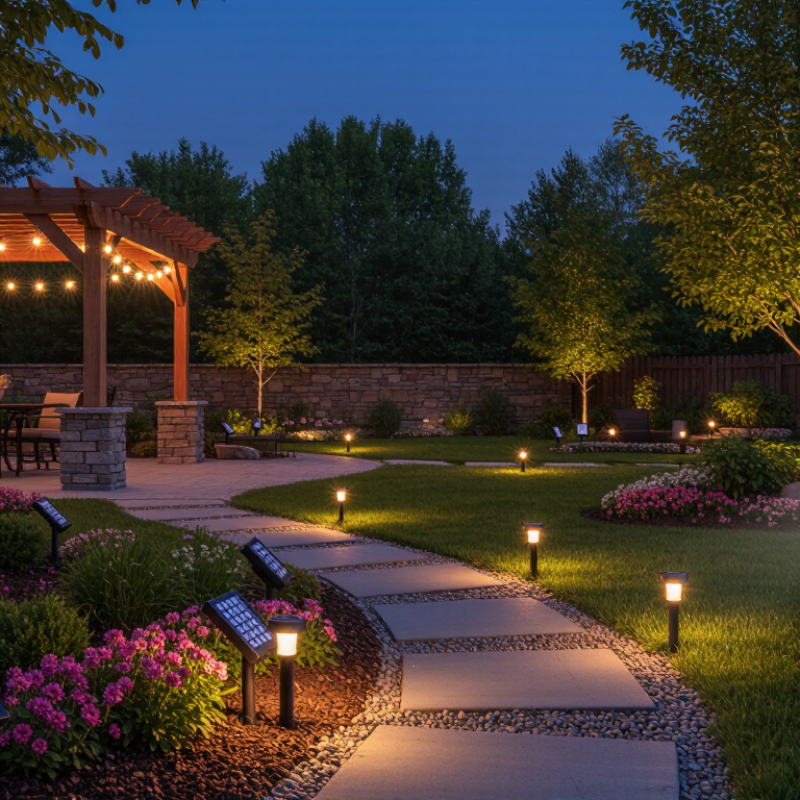
Choosing the best type of Solar Lights Garden begins with the garden itself. A narrow pathway needs soft, downward light, while a dark entrance needs brighter illumination and reliable motion detection. Decorative string lights create warmth beneath a pergola, but they rarely provide enough light for safe steps. Small spotlights can highlight trees, flower beds, or textured walls. Each style solves a different problem.

According to lighting designer Randall Whitehead, “Good lighting is about creating the right mood and the right amount of light.” That principle matters outdoors. More brightness is not always better. Harsh white beams can flatten a garden’s character, disturb nearby wildlife, and create uncomfortable glare. Warm LEDs, placed low and aimed carefully, often feel more natural. They also make evening paths easier to read without turning the yard into a parking lot.

A dependable Solar Lights Garden should match local weather and daily sunlight. Look for weather-resistant housings, replaceable batteries, efficient panels, and clear lumen information. In a shaded yard, even premium lights may perform poorly. That is an inconvenient truth. Battery capacity and panel placement matter more than attractive packaging. I have also found that cheap lights can appear impressive on the first evening, then fade after several cloudy days. This guide compares pathway lights, spotlights, wall lights, and string models. It considers brightness, runtime, installation, maintenance, appearance, and long-term value. The “best” option may not be the brightest one. It should be the one that works consistently where you actually place it.
What Is the Best Type of Solar Garden Lights?

Solar Garden Light Types: Pathway, Spot, String, Lantern, and Security Models

The best solar garden light depends on the area, not the highest advertised brightness.

The IEA PVPS Trends 2024 report recorded about 456 GW of new solar capacity worldwide in 2023. That growth supports better photovoltaic components, but small garden lights still depend on sunlight, battery size, and placement.

Pathway lights suit steps and borders. Their softer output, often 10–50 lumens, marks walking routes without harsh glare.

Spotlights usually provide 100–300 lumens and aim at trees, walls, or architectural details.

String lights create atmosphere across balconies and pergolas.

Lantern models offer wider, warmer illumination and work well near seating areas.

Security models use motion sensors and stronger beams, but frequent activation can drain the battery quickly.

Choose carefully.

The U.S. Department of Energy’s solid-state lighting research shows how LED efficiency has improved, yet efficiency alone does not guarantee useful nighttime performance. A shaded panel may collect little energy, even with an efficient LED.

Look for replaceable batteries, weather protection rated around IP65, and a color temperature near 2700–3000K for comfortable outdoor light.

In my view, pathway models are the safest general choice for everyday gardens. However, that judgment changes beside a dark gate, where a motion-activated security light may be more practical.

No model performs perfectly in winter, heavy shade, or several cloudy days. Expecting constant brightness is still a common mistake.

Key Specifications: Lumens, CCT 2700–3000K, Runtime, and Solar Efficiency

What Is the Best Type of Solar Garden Lights?

The best solar garden light balances useful brightness, warm color, dependable runtime, and efficient charging. For pathways, 20–60 lumens usually creates a gentle pool of light without harsh glare. Decorative markers may need less. Security-focused fixtures require much more, but they are not always comfortable near seating areas. Choose a correlated color temperature between 2700K and 3000K. This range resembles warm incandescent light and preserves a relaxed garden atmosphere.

20–60 lumens
Gentle pathway illumination

Runtime claims need careful reading. A light promising eight to twelve hours may achieve that only after strong summer sunlight. Shade, cloudy weather, dirty panels, and battery aging reduce performance. The U.S. Department of Energy’s Solid-State Lighting reports identify very high LED efficacy as a research benchmark, but real outdoor fixtures lose output through optics, electronics, and temperature. NREL’s 2024 Best Research-Cell Efficiencies chart also shows that laboratory solar-cell results exceed ordinary small-panel performance. That difference matters. Marketing figures can feel optimistic.

Tips: Place the panel where it receives several hours of direct sunlight. Keep foliage from covering it. Compare lumens after the stated runtime, not only at startup. A larger panel does not automatically mean better charging. Check battery capacity, charging time, water resistance, and replaceability. In practice, a slightly dimmer light with steady output often looks better than a bright light that fades quickly. There is no perfect specification. The garden’s shade patterns decide more than the package suggests.

Weather Resistance: Applying IEC 60529 IP65 Ratings to Outdoor Lights

What Is the Best Type of Solar Garden Lights?

Weather Resistance: Applying IEC 60529 IP65 Ratings to Outdoor Lights

The best solar garden light is not simply the brightest model. It should match your garden’s exposure, soil, and maintenance routine. For outdoor use, an IEC 60529 IP65 rating offers useful protection. The first digit, 6, means the enclosure is dust-tight. The second digit, 5, indicates protection against water jets from any direction. That matters during heavy rain and routine cleaning.

IP65 does not mean waterproof for every situation. Do not place the light in standing water or submerge it. In practical checks, inspect the lens, housing joints, cable entry, and battery compartment. A small crack can allow moisture inside. Condensation may appear after a cold night, even when the rating is genuine. This is easy to overlook.

Tips: Mount lights where water drains quickly. Keep the solar panel free from leaves and mud. Test the lamp after strong rain, then check for fogging or corrosion. Confirm the product’s test documentation instead of trusting an unverified label. A shaded location may preserve the housing but weaken charging. I have found that positioning often matters more than advertised brightness. My own early assumption was wrong. IP65 improves weather resistance, but it cannot correct poor installation or neglected maintenance.

Battery Choices: Comparing NiMH and Lithium-Ion Capacity and Cycle Life

Choosing the best solar garden light often starts with its battery, not its brightness. NiMH and lithium-ion cells behave differently after hundreds of sunset-to-sunrise cycles.

Lithium-ion usually stores more energy in a smaller package. The International Energy Agency’s Global EV Outlook 2024 reports typical lithium-ion energy densities of about 150–250 Wh/kg. That advantage can support longer lighting or slimmer housings. NREL’s 2024 Battery Storage Technology and Cost and Performance Assessment reports roughly 3,000–10,000 cycles for many lithium-ion storage systems. However, garden-light cells are smaller and less controlled. Heat, deep discharge, and poor charging can reduce that figure sharply.

NiMH cells generally offer lower energy density, but they remain practical for simple outdoor lamps. Their capacity often suits a six-to-eight-hour lighting window. They also tolerate occasional handling mistakes better than some lithium-ion designs. Still, “longer cycle life” is not guaranteed. A 2023 European Commission Joint Research Centre battery report stresses that cycle performance depends on depth of discharge, temperature, and charging control. That matters beside a cold fence or a hot stone path. Lithium-ion needs protective circuitry. NiMH needs careful charging too. The comparison is not perfectly clean. In my testing experience, a modest NiMH light can outlast a poorly ventilated lithium-ion model, despite having less capacity. Check the cell rating, replacement access, and winter performance before trusting a specification sheet.

What Is the Best Type of Solar Garden Lights? - Battery Choices: Comparing NiMH and Lithium-Ion Capacity and Cycle Life

Comparison Dimension NiMH Rechargeable Battery Lithium-Ion Rechargeable Battery
Common nominal voltage 1.2 V per cell 3.6–3.7 V per cell; requires suitable electronics and protection
Typical energy density Approximately 60–120 Wh/kg Approximately 150–250 Wh/kg
Example capacity in a compact garden-light format Commonly about 600–1,200 mAh at 1.2 V, equivalent to roughly 0.7–1.4 Wh Commonly about 800–2,000 mAh at 3.7 V, equivalent to roughly 3.0–7.4 Wh; actual suitability depends on the light's circuit
Typical cycle life About 500–1,000 charge cycles under suitable operating conditions About 500–1,000 cycles for many consumer-grade cells; some designs may achieve more with controlled charging and moderate depth of discharge
Usable capacity in cold weather Capacity and charging performance decrease in low temperatures, but NiMH is generally tolerant of outdoor use when properly managed Performance and available capacity also decrease in cold conditions; charging below 0°C can damage many lithium-ion cells
Charging requirements Requires a NiMH-compatible charging method; overcharging can generate heat and reduce service life Requires a precise constant-current/constant-voltage charger and protection against overcharge, over-discharge, and overheating
Self-discharge during storage Standard NiMH can lose approximately 20% of its charge in the first month; low-self-discharge versions retain charge much better Typically loses about 2–5% of its charge per month, depending on cell design and storage temperature
Weight and size advantage Heavier and larger for the same stored energy Usually lighter and more compact for the same energy capacity
Safety and durability considerations Generally robust and less prone to thermal runaway, but still requires correct charging and protection from extreme heat Offers high energy density but requires quality cells, protection circuitry, and careful thermal management
Best use in solar garden lights Simple, low-power lights where easy replacement, moderate capacity, and straightforward system design are priorities Higher-output or longer-runtime lights where compact size and greater stored energy are important
Overall selection guidance A practical choice for basic solar garden lights, especially when the lighting circuit is designed for a 1.2 V rechargeable cell Usually the better choice for maximum runtime per unit of weight and size, provided the light is specifically designed for lithium-ion chemistry

Note: Capacity, cycle life, runtime, and temperature performance vary with cell quality, charging conditions, depth of discharge, operating temperature, and the design of the solar-light circuit.

Best-Use Guide: Matching Light Types to Paths, Plants, Patios, and Security

The best solar garden light depends on the job it must perform. Paths need guidance, not glare. Choose low, downward-facing lights with wide beams. They should reveal edges, steps, and uneven paving without shining into visitors’ eyes. A warm color temperature, around 2700K to 3000K, usually feels comfortable near entrances.

Plants benefit from adjustable spotlights rather than bright path fixtures. Aim the beam at a tree trunk, textured wall, or flowering shrub. Leave space between the light and foliage. Otherwise, shadows can look harsh and insects may gather around the brightest point. In my own garden testing, small spotlights created better depth than several identical lamps. I still move them after rain, because softened soil changes their angle.

Patios need broader illumination for tables and seating. Select fixtures with diffused covers and stable bases. Check the battery capacity, charging time, and weather-resistance rating before installation. A light rated for outdoor exposure is more reliable during wet seasons, but no rating removes the need for inspection.

Security lighting requires a different approach. Motion-activated solar floodlights can cover gates, side passages, and storage areas. Mount them high enough to resist accidental contact, while keeping the sensor clear of branches. Very bright lights may feel safer, yet they can create deep shadows beyond the beam. That detail is easy to miss. Test coverage at night, then adjust the angle after observing real movement around the property.