
News
How to Choose Outdoor Xmas Lanterns in 2026?
Outdoor Xmas Lanterns will play a larger role in 2026 holiday decorating, as buyers seek warmth, efficiency, and dependable outdoor performance. The National Retail Federation reported that U.S. holiday spending reached a record $964.4 billion in 2023, showing the scale of seasonal purchasing. Deloitte’s 2024 holiday retail survey also found that consumers remain value-conscious, even when they continue spending on meaningful home experiences.
This matters when choosing lanterns. A low price can hide weak seals, fragile wiring, or batteries that fade before Christmas morning. Look for weather-resistant construction, stable bases, protected connectors, and timers that prevent unnecessary overnight use. LED bulbs usually reduce energy consumption and heat, while rechargeable models can reduce disposable battery waste. Still, “energy-efficient” does not automatically mean durable.
Lighting designer Richard Kelly described lighting through three purposes: “light for seeing, light for looking, and light for contemplation.” His idea fits outdoor holiday design surprisingly well. A lantern should illuminate steps, attract attention near the doorway, and create a calm glow across snow, stone, or evergreen branches.
In 2026, shoppers should compare brightness, color temperature, operating time, and repairability together. Warm white light often feels more welcoming than harsh blue-white light. However, personal taste matters. A perfect display does not exist.
This guide examines materials, safety features, smart controls, weather ratings, and seasonal value. It also questions popular assumptions, because attractive Outdoor Xmas Lanterns can still perform poorly outdoors.
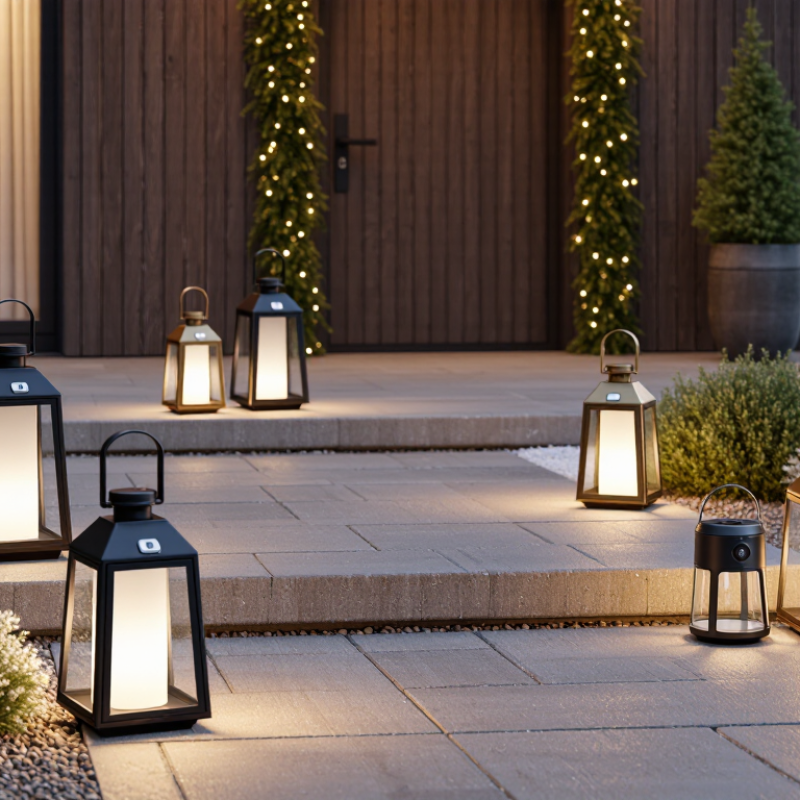
Understanding Outdoor Xmas Lantern Types and Their Uses
How to Choose Outdoor Xmas Lanterns in 2026?
Understanding Outdoor Xmas Lantern Types and Their Uses
Outdoor Christmas lanterns differ in power source, brightness, and weather suitability. Solar lanterns suit sunny patios and paths, where daytime charging can reduce wiring needs. Their output may fade after cloudy days, so check placement before relying on them for evening gatherings. Battery-powered lanterns are easier to move, making them useful on porch steps or dining tables. Keep spare batteries nearby. Plug-in models provide steady light near a protected outdoor outlet, but cords need careful placement to avoid trip hazards. For a candle-like glow, choose an LED flame-effect lantern rather than an open flame near dry greenery.
Material and light source matter, too. Metal frames create sharper shadows, while frosted panels soften the glow against snow or stone. Look for clear outdoor-use instructions and sealed construction suited to your exposure; a covered porch and an open, rainy garden are not the same setting. LED models are often practical for longer seasonal displays. The U.S. Department of Energy reports that LEDs use at least 75% less energy and last up to 25 times longer than incandescent lighting. That comparison concerns lighting generally, not every lantern’s real-world performance. Check the product’s stated runtime and replaceable-battery details. A lantern can look perfect in a shop and still feel too dim beside a dark walkway.
| Lantern Type | Typical Power Source | Best Placement | Weather Considerations | Main Advantages | Good Uses |
|---|---|---|---|---|---|
| Battery-powered LED lantern | Replaceable or rechargeable batteries | Porches, covered entryways, tables, and areas without a nearby outlet | Check the product’s stated outdoor suitability; remove or protect it during severe weather if it is not designed for exposure. | Portable, easy to position, and does not require a power cable. | Flexible seasonal displays and locations where wiring is inconvenient. |
| Solar-powered lantern | Rechargeable battery charged by a solar panel | Sunny garden borders, pathways, and other spots that receive direct daylight | Choose a model rated for the expected outdoor conditions. Shade and short winter days can reduce charging and nighttime run time. | No mains cable is needed; automatic dusk-to-dawn operation is common on many models. | Decorative garden lighting where daytime sun is available. |
| Plug-in electric lantern | Mains electricity through a power cord | Near a suitable outdoor-rated outlet, such as a porch or patio | Use equipment and connections intended for outdoor use, and follow the manufacturer’s instructions for keeping plugs and connections dry. | Provides continuous power while connected and avoids routine battery replacement. | Long-running displays close to a safely accessible outdoor outlet. |
| LED candle-style lantern | Usually batteries; some models are rechargeable or solar-powered | Porch steps, sheltered tables, windows, and decorative groupings | Confirm the complete lantern—not just its light source—is suitable for the intended outdoor exposure. | Creates a candle-like appearance without an open flame. | Decorative ambience in homes where a real flame is not appropriate. |
| Hanging lantern | Battery, solar, or plug-in, depending on the design | Covered porches, sturdy hooks, pergolas, or branches that can safely support it | Consider wind exposure and secure the lantern according to its instructions. A sheltered location can reduce exposure to rain and snow. | Uses vertical space and can add light above a seating or entry area. | Porch decoration, covered patios, and overhead festive displays. |
| Pathway or stake lantern | Often solar or battery-powered | Garden beds and along walkways, positioned so they do not obstruct foot traffic | Check that the stake and lantern are made for outdoor placement; secure them in suitable ground and account for snow or lawn maintenance. | Places decorative light near ground level without requiring a table or hanging point. | Marking garden edges and adding seasonal accents beside paths. |
| Weather-resistant decorative lantern | May be battery, solar, or plug-in | Open-air porches, patios, and garden areas, subject to the product’s rating | Read the specific IP rating and manufacturer guidance. For example, IP44 indicates protection against solid objects 1 mm and larger and water splashing from any direction; it does not mean the product is waterproof or suitable for immersion. | Designed for a defined level of exposure when installed and used as directed. | Outdoor locations where rain or splashing is a consideration; match the rating to the actual conditions. |
