
News
How to Choose the Best Arc Floor Lamp in 2026?
Arc Floor Lamps can bring reading light over a sofa without requiring a ceiling fixture, but their sweeping shapes can be easy to misjudge. A lamp that looks graceful online may crowd a narrow walkway or place its shade too far from the chair. In 2026, choosing well still starts with the room, not the trend. Measure the seat, nearby table, ceiling height, and lamp footprint before comparing finishes.
Look for a steady, weighted base and an arm that reaches where you actually read. Check whether the shade directs light downward, whether its height adjusts, and whether the bulb and dimming controls suit your habits. Product listings should state dimensions, materials, bulb compatibility, and care details. Unclear specifications deserve a closer look. That matters. Also consider the cord route, especially beside a doorway or rug. A beautiful lamp can become irritating when its plug crosses the only clear path.
This guide compares practical features, styles, and common trade-offs to help you choose an arc floor lamp for your space and budget. Some rooms need broad ambient light; others need a focused pool on a book. There is no single best model. Personal preference still counts: a slightly imperfect finish may feel warmer than a technically perfect lamp. The right choice should fit safely, light the task, and feel natural in daily use.
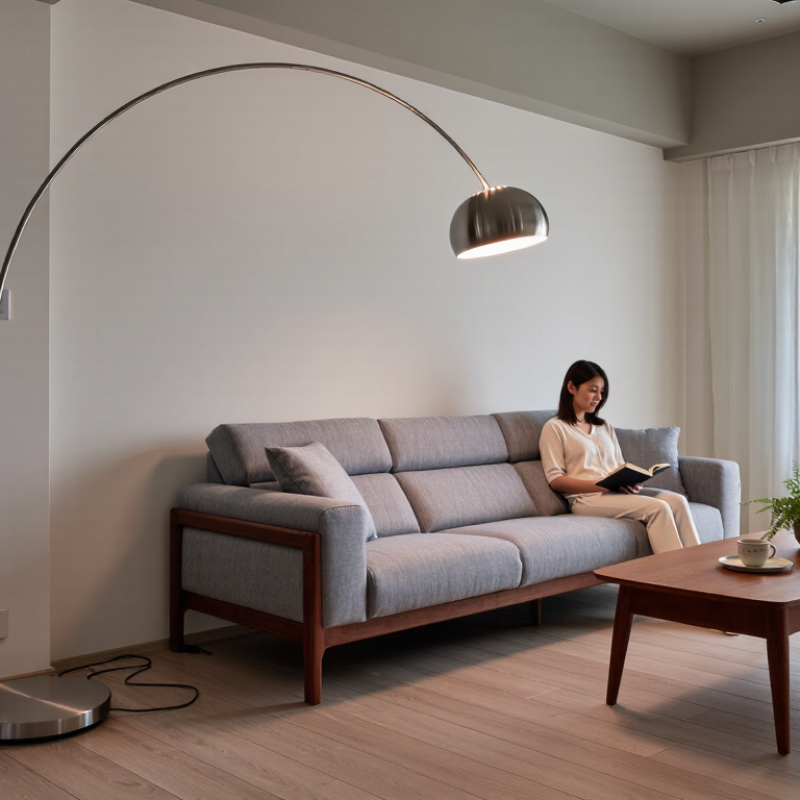
Define the Lighting Task Using the 300–500 lx Reading Benchmark
For reading, use 300–500 lx as a practical target on the page, not as a brightness rating for the bulb. Lux describes light reaching a surface. An arc lamp may look bright across the room yet leave a book dim if its shade sits too high or points away.
Place the lamp beside or slightly behind your reading seat, then aim the shade toward the open pages. Keep the beam off your eyes and check for glare on glossy paper. Measure at page level with a light meter, if available; phone apps can offer only rough estimates. Measure twice. A reading near 300 lx may suit a bright room, while 500 lx can help when surrounding light is low.
The right level depends on print size, contrast, eyesight, and personal comfort. Start within the range, then adjust the lamp and dimmer while reading for several minutes. Notice whether your hand casts a shadow or your eyes begin to strain. I would not treat one measurement as a perfect answer; meter placement and changing daylight can shift the result. A lamp that reaches the target comfortably is more useful than one that merely looks dramatic.
How to Choose the Best Arc Floor Lamp in 2026? - Define the Lighting Task Using the 300–500 lx Reading Benchmark
| Lighting task | Practical illuminance target | Where to assess it | Arc-lamp planning consideration | How to check the result |
|---|---|---|---|---|
| Reading a printed book or magazine | 300–500 lx | On the open page in the usual reading position | Position the lamp head so light reaches the page without shining directly into the reader’s eyes. | Measure at page level with a lux meter while seated in the normal position. |
| Reading with reduced ambient room lighting | 300–500 lx on the page | On the page, with the room’s usual background lighting switched on | A dimmer can help adjust the lamp as ambient light changes; avoid making the page bright while the surrounding room remains uncomfortably dark. | Check the page and surrounding area separately; the reading target applies to the task area. |
| Light writing or note-taking | 300–500 lx | Across the writing surface | Allow enough reach for the arc to place the light over the desk or side table, while keeping the base stable and out of walkways. | Take readings at several points on the work surface to spot uneven lighting. |
| General seating-area illumination | About 100–200 lx | At the seating area or nearby horizontal surfaces | Use a shade that distributes light comfortably; a floor lamp may supplement, rather than replace, room lighting. | Measure at the surface where light is needed, not directly beneath the bulb or shade. |
| Close-up hobby or detailed handwork | About 500 lx or more, as needed | On the detailed work area | Look for adjustable positioning and brightness, and arrange the beam to reduce hand shadows and glare. | Increase illumination gradually and recheck for reflections, eye discomfort, and shadows. |
| Glare and placement check | No single lux target | From the normal seated viewpoint and across the task surface | Confirm that the shade does not obstruct movement or create direct glare; check that the lamp’s arc clears furniture and overhead obstacles. | Test the lamp from the actual seating position and at the intended shade height. |
Planning note: Lux (lx) measures illuminance on a surface. The 300–500 lx reading range is a practical task-lighting benchmark, not a guarantee of comfort for every reader. Results depend on room lighting, shade design, lamp position, surface reflectance, and eyesight. Measure at the page or work surface, and follow applicable local electrical and product-safety guidance.
