
News
Who Is the Top Red Light Therapy Manufacturer in China?
Choosing the top Red Light Therapy Manufacturer in China takes more than comparing prices or browsing polished product photos. A professional assessment should look at measurable specifications, production consistency, and the evidence a supplier can provide. Small details matter. For example, a buyer should check the stated wavelengths, irradiance measurement conditions, treatment-area coverage, and temperature control. Clear answers are more useful than impressive claims.
This overview considers manufacturers through practical questions: Do product datasheets match test reports? Can the company explain how it checks output across a panel, rather than at one convenient point? Are quality procedures, warranty terms, and after-sales support described in writing? Factory experience and communication also matter, especially when discussing custom designs or repeat orders. These checks do not prove that a device will suit every user or application. They do help separate verifiable information from marketing language. A polished catalog is not proof. And no single specification tells the whole story.
There is room for judgment here. Public information can be incomplete, and supplier claims may be difficult to compare when test methods differ. This guide therefore focuses on transparent evidence, realistic product details, and questions buyers can raise before making a decision. The goal is not to declare a winner without qualification, but to show what a credible manufacturer should be able to demonstrate.
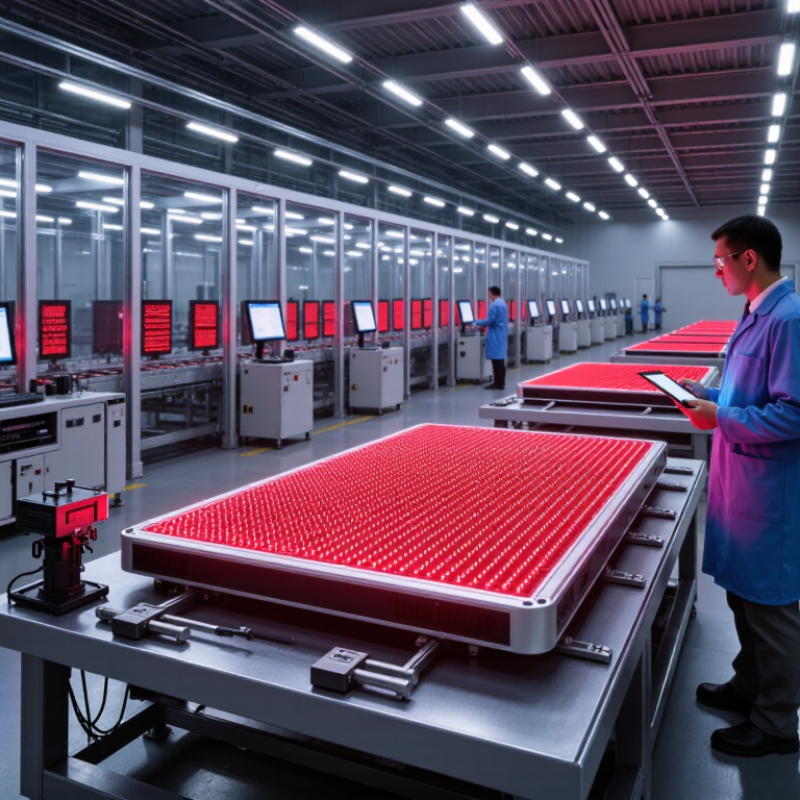
What Red Light Therapy Is and How Its Devices Work
Red light therapy uses low-level red and near-infrared light, often delivered by LEDs or laser diodes. Unlike ultraviolet light, these wavelengths are not intended to tan or visibly burn the skin. A panel may stand beside a treatment chair, while a handheld device covers one small area at a time. Light travels toward the skin, where some photons are absorbed by cells rather than reflected. Simple enough.
Research suggests this exposure may influence cellular energy processes and local signaling, but responses can vary. Wavelength, output, distance, session length, and coverage all affect the dose delivered. More power is not automatically better. Findings are encouraging for some uses, yet results differ by condition and study design. The science is promising, not settled.
When assessing a device, look for measured wavelength and irradiance, not just a bright-looking panel. Check whether output was tested across the treatment surface and at the stated distance. Clear instructions, thermal control, and consistent construction matter in daily use. A warm casing or uneven light can be easy to overlook. Specifications cannot promise a personal result; people respond differently, and expectations deserve a second look.

How China’s Red Light Therapy Manufacturing Industry Is Structured
China’s red light therapy sector is best understood as a supply chain, not a single factory category. Upstream suppliers produce LED chips, circuit boards, drivers, lenses, heat sinks, and housings. Specialized assemblers combine these components into panels, masks, or handheld devices. Some manufacturers manage design and production in-house; others work with contract partners. That distinction matters.
The National Bureau of Statistics of China reported that manufacturing value added grew 5.0% in 2023. This broad figure reflects industrial activity, not red light device production specifically. Grand View Research valued the global light therapy market at USD 1.1 billion in 2023, but its category includes more than red light therapy. Read the figures carefully.
When assessing a supplier, ask for measured irradiance at a stated distance, wavelength test results, and batch-level quality records. Check how the device handles heat after extended use. A polished sample proves little. I would also compare production units, not just the demonstration model; small differences can slip through. These details reveal more about manufacturing discipline than a factory’s size alone.
What Makes a Chinese Manufacturer a Market Leader?
A market-leading Chinese red light therapy manufacturer must prove more than low pricing and attractive product photos. Buyers should examine irradiance measurements, wavelength tolerance, thermal control, and batch-to-batch consistency. Ask for test records showing how output was measured, at what distance, and across which treatment area. Small details matter: a reading taken directly against a panel may not represent light reaching a user’s skin. Clear answers build trust.
The commercial opportunity is growing. Grand View Research valued the global photobiomodulation devices market at about
US$199.6 million in 2023 and projected a 9.2% compound annual growth rate from 2024 to 2030.
That forecast is not proof that every factory can deliver reliable equipment. It does raise the bar. A capable supplier should document component sourcing, electrical and optical safety testing, production inspections, and complaint handling. Ask to review anonymized inspection records, not only a polished sample unit. Consistency takes work.
A weakness in many supplier evaluations is overreliance on specifications; real-world durability and service response deserve equal scrutiny. One report cannot settle the question. Availability of independent verification, transparent limitations, and responsive technical support are stronger signs of leadership than volume claims alone.
How to Compare Leading Red Light Therapy Manufacturers in China
When comparing leading red light therapy manufacturers in China, look beyond catalog photos and headline specifications. Ask for the exact wavelength range, output measurement method, and testing distance for each device. A reading taken five centimeters away cannot be fairly compared with one measured at the panel surface. Small details matter.
Request recent test reports, electrical safety documentation, and clear explanations of quality checks. Confirm how the factory controls LED selection, heat dissipation, assembly tolerances, and final inspection. If figures vary between documents, ask why before accepting a quotation. Numbers need context. Clear evidence is more useful than broad claims about performance or lifespan.
Evaluate a sample under realistic conditions. Check timer accuracy, fan noise, cable strain relief, and whether the controls are easy to read. Discuss lead times, spare parts, warranty terms, and how defects are handled. A factory visit or live production walkthrough can help verify capacity, though neither replaces independent testing. I would not rank suppliers from one polished sample alone; that is an easy mistake. Compare several units, keep written criteria, and note what remains uncertain.
| Comparison Dimension | Why It Matters | Evidence to Request | How to Compare Providers |
|---|---|---|---|
| Manufacturer status and production capability | A supplier’s ability to control production, inspection, and engineering changes affects consistency and traceability. | Factory address, production-line overview, process flow, sample production records, and an independent factory-audit report where available. | Confirm that the facility and processes match the supplier’s claims. Distinguish in-house production from outsourced assembly or trading activities. |
| Wavelength specifications | Red and near-infrared devices use different wavelengths; the stated wavelength should be clear and verifiable for each model. | Model-specific spectral test report, wavelength tolerance, and the measurement method or instrument used. | Compare the measured output with the product specification. Do not assume two devices are equivalent based only on labels such as “red light” or “near-infrared.” |
| Irradiance and measurement conditions | Irradiance values are meaningful only when the measurement distance, test area, and method are specified. | Test results in mW/cm², measurement distance, measurement locations, and a description of the test setup. | Compare results at the same distance and under comparable conditions. Treat figures without a stated method or distance as incomplete. |
| Coverage area and light distribution | Usable treatment coverage and uniformity can differ even among devices with similar dimensions or LED counts. | Illuminated-area measurements, a light-distribution map where available, and product dimensions. | Check whether output is measured across the usable area, rather than only at a single central point. |
| Electrical and product safety | Electrical safety, thermal management, and construction quality are important for products used close to the body. | Model-specific safety test reports, electrical ratings, temperature or thermal test information, and applicable market documentation. | Verify that reports identify the exact model and configuration. Check requirements for the destination market rather than relying on a general claim of compliance. |
| Quality management and production controls | Documented controls can help support repeatable production and consistent inspection. | Current quality-management certificates, their scope and issuing body, inspection procedures, and batch traceability examples. | Check certificate validity and scope directly. A quality-system certificate is not, by itself, proof that a particular product is certified or effective. |
| Regulatory documentation and claims | Regulatory requirements depend on the product design, intended use, claims, and target market. | Applicable declarations, registrations or clearances, test reports, labeling, and instructions for use. | Match documentation to the exact model and intended market. Be cautious of broad claims that do not identify the relevant product or regulatory basis. |
| Customization and engineering support | Custom wavelengths, controls, housings, or packaging may require engineering review and additional validation. | Written specifications, sample approval process, change-control procedure, and details of engineering support. | Ask how design changes are documented and how the final production unit is checked against the approved sample. |
| Warranty, spare parts, and after-sales service | Clear support terms help buyers plan for repairs, replacements, and product lifecycle needs. | Written warranty terms, exclusions, spare-parts availability, repair process, and response-time commitments. | Compare the written terms and service process, not just verbal assurances. Confirm how support works for the destination country. |
| Commercial terms and delivery capability | Minimum order quantity, lead time, and shipping terms vary by model, customization, and order size. | Itemized quotation, stated MOQ, production lead time, Incoterms, packaging details, and sample charges. | Compare like-for-like quotations with the same configuration, order quantity, packaging, and delivery terms. Treat quoted lead times as supplier-specific. |
How to Verify a Manufacturer’s Quality, Compliance, and Reputation
A reliable assessment starts beyond the catalog. Request the factory address, production-flow details, and a live video tour showing assembly, testing, and packaging. Look for consistent controls, not just clean floors. Ask how staff record device output, inspect wiring, and handle failed units. A showroom can impress.
Check certificates with issuing organizations, and confirm that each document covers the actual device and factory. Compare test reports against model numbers, wavelengths, irradiance, electrical safety, and labeling. These details matter because a report for one configuration may not support another. Request calibration records and sample inspection logs. Ask for evidence.
For your target markets, ask which standards and product requirements apply, then verify claims with qualified testing or regulatory professionals. Review warranty terms, spare-part access, complaint handling, and response times. Speak with long-term customers, if possible, and ask whether delivered units match approved samples. Paperwork can look complete while production varies between batches. Request records from two separate batches and compare their measured output.
Who Is the Top Red Light Therapy Manufacturer in China?
There is no reliable single ranking without independently verified, comparable evidence. Start by checking whether a manufacturer’s published wavelength specifications are precise and testable.
Photon Energy at Example Red and Near-Infrared Wavelengths
Photon energy is calculated from wavelength using E = hc/λ; the plotted values are physics calculations, not product test results or a measure of treatment effectiveness. When evaluating a manufacturer, request independent test reports confirming wavelength and irradiance, applicable electrical-safety and EMC documentation, and evidence that certificates and regulatory claims can be verified. Requirements vary by market; FDA registration or listing alone does not mean a device is FDA-cleared or approved.