
News
Why Are Carbon Fiber Products in High Demand?
Why are carbon fiber products in high demand? The answer begins with a practical advantage: they can deliver high strength at low weight. That matters when aircraft makers seek lighter structures, wind-energy companies build larger turbines, and vehicle manufacturers work to reduce mass. Carbon fiber is not a universal fix. Its price and manufacturing demands still limit some applications.
Grand View Research valued the global carbon fiber market at approximately $5.48 billion in 2023 and forecast an 11.0% compound annual growth rate from 2024 to 2030. This is a market forecast, not a guarantee. The Global Wind Energy Council reported 117 gigawatts of new wind capacity in 2023, illustrating one expanding market for advanced composite materials. Yet not every turbine component uses carbon fiber; material choices depend on design, cost, and performance.
A useful expert perspective comes from Dr. Uday Vaidya, a composites researcher and the University of Tennessee’s chief technology officer for the Institute for Advanced Composites Manufacturing Innovation. As a paraphrase of the manufacturing challenge emphasized in his work: adoption depends on making advanced composites practical to produce at scale, not merely strong in a laboratory. That distinction matters. The benefits are visible in a lightweight bicycle frame or aircraft component, but so are the trade-offs in cost, repair, and end-of-life handling. The gains are real. Not effortless. Understanding both sides helps explain why demand is rising—and why it will vary by product and industry.
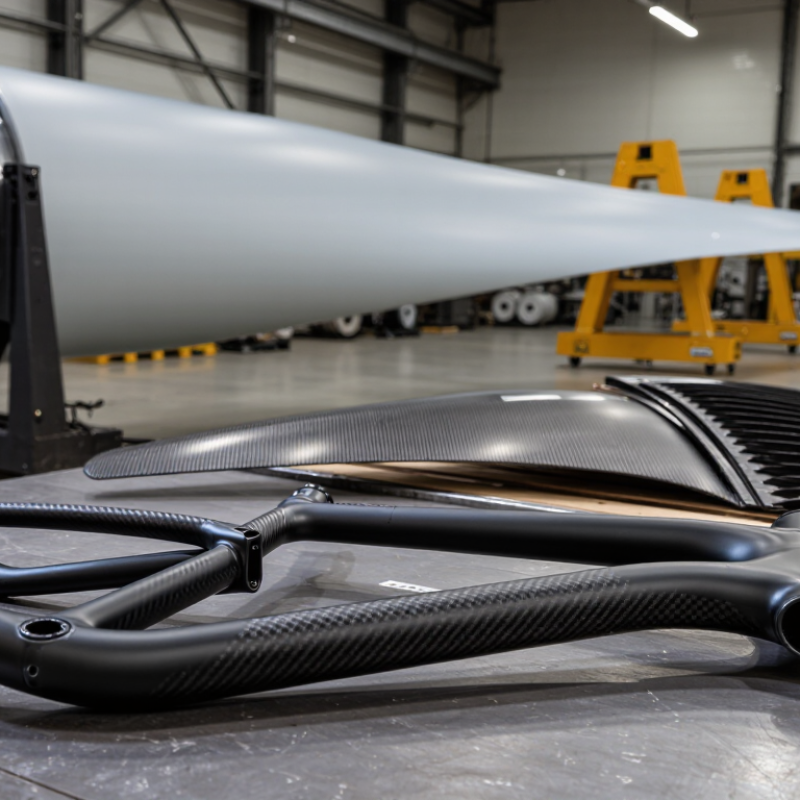
What Carbon Fiber Products Are and How They Are Made
Why Are Carbon Fiber Products in High Demand?
What Carbon Fiber Products Are and How They Are Made
Carbon fiber products are made from thin carbon-based filaments, bundled into yarn and combined with a polymer resin. The result is a composite: fibers carry much of the load, while resin holds them in shape. Making the fibers involves heating a precursor, often polyacrylonitrile, through controlled stabilization and high-temperature carbonization. Manufacturers then weave or layer the fibers, add resin, and cure the shaped part under heat or pressure. A finished panel may show a fine woven pattern, but its strength depends on fiber direction, resin quality, and careful production.
Products range from sporting goods to vehicle and aircraft components. Grand View Research estimated the global carbon fiber market at USD 5.48 billion in 2023. That figure reflects market value, not the quantity or performance of every product. Carbon fiber can be lightweight and stiff, but it is not automatically the best choice. Resin systems, repair needs, and end-of-life handling matter too. These trade-offs deserve more attention than they often receive.
Tips: Check the product’s intended load and fiber orientation. A glossy surface alone tells you little. Ask whether the part is solid laminate or a thin decorative layer.

Key Properties That Make Carbon Fiber Highly Desirable
Why Are Carbon Fiber Products in High Demand?
Key Properties That Make Carbon Fiber Highly Desirable
Carbon fiber stands out for its high strength-to-weight ratio. Typical carbon-fiber composites have densities around 1.5–1.6 g/cm³, compared with roughly 7.8 g/cm³ for steel; exact values vary with fiber, resin, and layup. This difference matters in aircraft structures, bicycle frames, and vehicle panels, where every kilogram can affect performance. The U.S. Department of Energy notes that reducing a vehicle’s weight by 10% can improve fuel economy by about 6–8%. Carbon fiber can help designers pursue that reduction without simply making parts thicker. It is stiff, too. A thin panel can feel rigid under load, though a poorly designed joint may still fail.
The material also resists corrosion and allows complex shapes to be molded with fewer separate parts. But it is not a universal upgrade. Carbon-fiber components can be costly, difficult to repair, and vulnerable to impact damage that is hard to spot beneath the surface. A dent may look minor. It may not be. These trade-offs make engineering choices and inspection plans essential, rather than optional details.
Tips: Check the product’s fiber direction, resin system, and tested load rating—not just the phrase “carbon fiber.” For vehicle applications, compare the claimed weight saving with the full assembly, including fasteners and repairs. DOE fuel-economy figures describe vehicle weight reduction generally, not a guaranteed result from using carbon fiber.
Industries Driving Demand for Carbon Fiber Products
Aerospace remains a major market for carbon fiber products because every kilogram saved can improve payload or fuel efficiency. Composite panels and structural parts are used in aircraft where strength and low weight matter. Yet inspection and repair can be more demanding than with familiar metals. Weight matters, but so does maintenance.
Automotive manufacturers use carbon fiber in selected body panels, chassis components, and performance vehicles. Wider adoption is slower because the material and production processes can be costly. Wind energy is another important driver: long turbine blades need materials that balance stiffness with manageable weight. Carbon fiber can reinforce sections exposed to heavy loads, though it is not automatically the best choice for every blade. Sporting goods makers also use it in bicycle frames, tennis rackets, and fishing rods, where stiffness can improve handling. Demand is growing across these industries, but supply chains, recycling options, and repair methods still need attention. Not everywhere. The practical question is whether a product’s performance gains justify its full cost and end-of-life impact.
Why Are Carbon Fiber Products in High Demand? - Industries Driving Demand for Carbon Fiber Products
| Industry | Common Carbon Fiber Products | Key Demand Drivers | Adoption Considerations |
|---|---|---|---|
| Aerospace | Aircraft fuselage and wing structures, interior components, and spacecraft structures | High strength-to-weight ratio can reduce structural mass, supporting fuel efficiency or payload capacity. Good fatigue and corrosion resistance are also valuable in demanding service environments. | Certification, inspection, repair, and manufacturing costs are substantial considerations. |
| Wind Energy | Selected wind-turbine blade components, particularly spar caps and structural reinforcements | Stiff, lightweight reinforcement can help enable longer blades, which can capture more wind and increase the energy output of a turbine. | Carbon fiber is used selectively; material cost, blade design, and manufacturing economics affect whether it is suitable. |
| Automotive and Motorsports | Body panels, chassis parts, drive-shaft components, and structural reinforcements | Reducing vehicle mass can support handling and performance, and may help improve energy efficiency or electric-vehicle range when the overall design benefits from the weight reduction. | Higher material and production costs, repair practices, and high-volume manufacturing requirements can limit use, especially in mass-market vehicles. |
| Pressure Vessels and Hydrogen Storage | Composite overwraps for high-pressure gas cylinders and storage vessels | Carbon fiber reinforcement helps vessels withstand high internal pressure while keeping weight lower than many all-metal alternatives. | Design standards, safety testing, winding processes, and the cost of fiber are key factors in deployment. |
| Sporting Goods | Bicycle frames, tennis racquets, fishing rods, golf shafts, and ski components | Low mass, stiffness, and the ability to tailor a product's flex and strength can improve performance and handling. | Impact damage can be difficult to assess, and products generally cost more than comparable conventional alternatives. |
| Construction and Infrastructure | Fiber-reinforced polymer rebar, bridge strengthening laminates, and structural profiles | Corrosion resistance and high strength can be useful in harsh environments, retrofit projects, and structures where reducing added weight is important. | Initial material cost, building-code acceptance, installation expertise, and long-term performance requirements shape adoption. |
Note: Carbon fiber is selected when its performance benefits justify its cost; it does not replace conventional materials in every application.
How Cost and Production Capacity Shape Market Growth
Carbon fiber is valued for its strength-to-weight ratio, but performance alone does not explain its growing market. Cost matters. Carbon fiber feedstock, specialized tooling, skilled labor, and energy-intensive curing all add expense. For buyers, the final price also depends on part shape, production volume, and inspection requirements. A small, complex component can take considerable hands-on work, even when it uses little material.
Production capacity shapes what manufacturers can deliver and when. Curing equipment, controlled workspaces, and trained staff cannot always be expanded quickly. When orders rise, limited production slots may stretch lead times or push prices higher. Larger production runs can spread setup costs across more parts, though savings depend on stable designs and reliable process control. There is a catch. Rushing output can increase defects and waste, which may erase those savings.
Manufacturers are working to improve automation and reduce material waste, but scaling is not simply a matter of adding machines. Each new process needs testing to maintain consistent quality. Buyers can help by sharing realistic forecasts and avoiding unnecessary design changes late in production. Still, forecasts are imperfect, and capacity plans can miss the mark. That uncertainty is easy to overlook.
Emerging Uses and Future Demand Trends
Carbon fiber’s emerging uses are moving beyond aircraft and racing vehicles. Wind turbine blades use carbon-fiber reinforcements to stay lighter and stiffer as blades grow longer.
The Global Wind Energy Council’s Global Wind Report 2024 recorded 117 gigawatts of new wind capacity in 2023. It forecasts 1,210 gigawatts of new installations from 2024 to 2030. That expansion could support demand for advanced composites, though it does not translate directly into carbon-fiber sales.
Hydrogen storage is another developing application: carbon-fiber-wrapped pressure vessels can hold compressed gas while limiting weight. Automakers also use the material selectively in vehicle structures, where every kilogram saved can help extend electric-vehicle range.
Grand View Research valued the global carbon fiber market at 5.48 billion U.S. dollars in 2023 and projected an 11 percent compound annual growth rate from 2024 to 2030. These figures indicate momentum, not certainty.
High material and processing costs still restrict broader use, and recycling remains difficult. The growth story is real, but not effortless.