
News
Why Do Buyers Choose Carbon Filters?
Buyers choose Carbon Filters because they can reduce many odors and certain airborne or waterborne contaminants. Their appeal is practical: a compact cartridge can fit beneath a sink, inside a refrigerator, or within an air purifier. The black, porous media offers a large surface area where selected compounds can be captured. It is not magic. Performance depends on the contaminant, filter design, contact time, and replacement schedule.
Indoor-air researcher Dr. Richard Corsi’s work supports a useful principle: filtration should match the pollutant and the space. This is a paraphrase, not a verbatim quotation. A buyer comparing two products should look beyond the front label. Check the rated contaminants, capacity, operating conditions, and replacement guidance. A filter that reduces chlorine taste may not address every dissolved chemical. An air filter that helps with some vapors may still miss particles or gases it was not designed to capture.
Small details matter. A loose cartridge seal can let water bypass the media. A saturated filter can lose effectiveness, even when it still looks clean. That is easy to forget. Carbon filters also differ widely in media quantity and construction, so broad claims deserve careful checking. The best choice is usually the one supported by clear test information and suited to a specific need. Buyers may want cleaner-tasting water, less odor, or improved indoor comfort. Those goals are not identical. Choosing well means asking what the filter can reduce, what it cannot, and when it needs replacing.
What Carbon Filters Are and How They Are Made
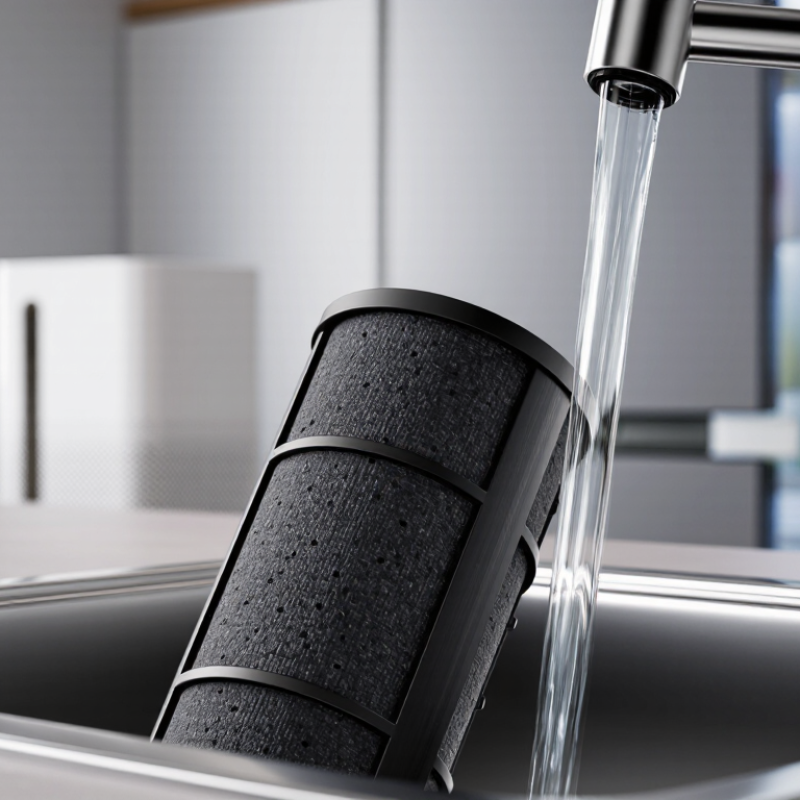
Carbon filters use activated carbon to adsorb certain chemicals as water or air passes through a porous bed. They are made from carbon-rich materials, including coal, wood, or coconut shells. Heat first drives off moisture and volatile compounds. A second, high-temperature activation step—using steam or carbon dioxide—opens a network of tiny pores.
The U.S. EPA’s Engineering Bulletin, Granular Activated Carbon Treatment (1991), reports typical surface areas of about 500–1,500 square metres per gram.
That enormous internal area gives contaminants many places to attach. It is not a universal trap.
Buyers often choose carbon because it can reduce chlorine taste and odour, and adsorb some organic compounds. Granular media lets water flow through loose particles; carbon block presses fine carbon into a denser shape. That difference affects contact time and flow.
Small details matter. EPA treatment guidance describes performance as dependent on the contaminant, water chemistry, and operating conditions, so a filter’s claims should be checked against independent test data.
Carbon can become exhausted, too. A filter may still look clean while its adsorption capacity has declined, which is easy to overlook.
Carbon filtration also does not reliably remove every dissolved salt, mineral, or microorganism; buyers should match the system to a tested need.

How Activated Carbon Captures Contaminants
Why Do Buyers Choose Carbon Filters?
How Activated Carbon Captures Contaminants
Activated carbon works by adsorption: dissolved molecules cling to the carbon’s vast internal surface rather than passing through a fine screen. Its pores create an enormous contact area. The U.S. EPA’s Engineering Bulletin on Granular Activated Carbon Treatment reports typical surface areas of roughly 500–1,500 square metres per gram. That’s a lot of surface in a small cartridge. As water flows through, compounds such as many taste- and odour-causing chemicals can attach to the carbon. Performance depends on pore structure, water chemistry, flow rate, and contact time—not just the word “carbon” on a label.
The EPA Drinking Water Treatability Database documents granular activated carbon treatment for a range of drinking-water contaminants, while emphasizing that removal varies by compound and operating conditions. For PFAS, longer-chain compounds generally adsorb more readily than shorter-chain ones. That sounds simple. It isn’t. Once adsorption sites fill, contaminants can pass through, sometimes before water looks or smells different. A cartridge’s replacement interval therefore matters; appearance alone is a poor warning. In practice, check the filter’s stated contaminant claims and supporting test data. Carbon can be highly useful, but it does not remove every contaminant, and a neglected filter can give a false sense of security.
Which Water and Air Pollutants Carbon Filters Can Reduce
Carbon filters work by trapping certain chemicals on porous carbon surfaces, but the target pollutant matters. In drinking water, activated carbon can reduce chlorine taste and odor, and some volatile organic compounds, pesticides, and PFAS. Performance depends on the filter design, water chemistry, and timely cartridge replacement. The USGS’s 2023 national study estimated that at least one PFAS may occur in nearly half of U.S. tap water samples. That finding describes contamination, not filter performance. The EPA’s 2024 drinking-water rule set limits of 4 nanograms per liter for PFOA and PFOS; meeting such limits requires verified treatment, not simply a carbon label. Not every molecule.
In indoor air, carbon media can adsorb some gases and odors, including certain VOCs released by paints, cleaners, or furnishings. The EPA’s Residential Air Cleaners technical summary explains that gas-phase filters work best for pollutants they are designed to target. They do not replace particle filters for dust, pollen, or smoke particles. A thin carbon sheet may hold little contaminant, while a deeper bed offers more contact time. Even then, saturation can be hard to notice. A room may smell fresher without every pollutant being removed, so product claims and replacement guidance deserve a careful look.
Why Buyers Choose Carbon Filters for Everyday Use
Buyers often choose carbon filters because ordinary water problems are immediate: a chlorine smell when filling a glass, or an unpleasant taste in morning tea. Taste matters. Activated carbon adsorbs some compounds that affect taste and odor, making it useful for everyday drinking and cooking. The U.S. EPA’s guidance on home water treatment notes that performance depends on the contaminant and the treatment system. Buyers should check a filter’s specific certification claims, rather than assuming “carbon” means it removes everything.
Convenience also counts: a pitcher or faucet-mounted unit can fit a small kitchen, and replacement cartridges are usually straightforward to install. But maintenance is easy to overlook; a neglected cartridge may lose effectiveness, so follow its replacement schedule. The WHO/UNICEF Joint Monitoring Programme reported that 2.2 billion people lacked safely managed drinking water in 2022. That figure describes a global access gap, not a benefit proven for carbon filters. For households concerned about a particular contaminant, test results and local water reports matter. Carbon can improve everyday taste, but it is not a universal safety barrier and may not address microbes, nitrate, or every metal.
What Buyers Consider When Selecting a Carbon Filter
Buyers should start by identifying what the filter needs to treat: drinking water, indoor air, or another application. Activated carbon can reduce certain compounds, but performance depends on the carbon, filter design, and contact time. For water, it often improves chlorine taste and odor. It does not automatically remove microbes, metals, or every dissolved contaminant. Check the exact reduction claims, not just the words “carbon filter.”
Fit matters. Buyers should compare the filter’s rated flow with daily demand; a fast flow can mean less contact time. Check capacity and replacement intervals, too. A small cartridge may need frequent changes in a busy household. Look for independent testing that covers the specific contaminant and intended use. A broad certification claim may not confirm every reduction a buyer cares about. Check the label.
Installation and upkeep are practical concerns, not fine print. Measure the available space, confirm compatible connections, and consider how easy the cartridge is to replace. Some filters perform poorly when neglected, and exhausted carbon may no longer reduce the target compounds effectively. That detail is easy to overlook, even for careful buyers. I would also question any claim that sounds universal: source water and indoor conditions vary, so one filter is rarely the right answer for every setting.