How to Choose Solar Powered Street Lights
Choosing Solar Powered Street Lights is not simply a matter of comparing panel wattage or price. The right system must provide useful light after sunset, through seasonal changes and cloudy weather. That requires matching the fixture’s output and distribution to the road, walkway, or parking area. A bright lamp with poor optics can waste energy and leave dark patches.
The economics are changing. IRENA’s Renewable Power Generation Costs in 2023 report found that the global weighted-average levelized cost of electricity from newly commissioned utility-scale solar PV reached USD 0.044 per kilowatt-hour, about 90% below its 2010 level. This trend supports wider solar adoption, but it does not guarantee that every street-light installation will perform well. Site conditions matter. A pole shaded by trees, a small battery, or several overcast days can change the result.
Look beyond headline claims. Check the required lighting area, mounting height, battery capacity, panel size, operating temperature range, and protection against dust and water. Ask how many nights of autonomy the system is designed to provide, and whether its specifications were tested under clear, repeatable conditions. The U.S. Department of Energy’s guidance on outdoor lighting also emphasizes choosing appropriate light distribution and limiting unnecessary light. That is practical advice. Still, product sheets can be incomplete, and real sites are messy. This guide explains how to compare systems, verify key specifications, and choose a design suited to your location—not just the catalog.
Define the Lighting Requirements for the Site
Start by defining what the street must help people do. Walk the route after dark and note where pedestrians cross, vehicles turn, and people pause. Measure the road width, path length, and distance between intersections. A narrow walkway needs different coverage from a broad parking area. Look up, too. Trees and nearby buildings can shade solar panels, especially as seasons change.
Decide which areas need the most consistent light. Entrances, crossings, and sharp bends often deserve closer attention than straight, low-traffic stretches. Consider brightness, even coverage, and glare together; a very bright pool beside a dark patch can make visibility worse. Check local lighting guidance before setting target levels. My first site sketch is often wrong. Revisit it at night and compare it with what people actually need to see.
Record how many hours the lights should operate and whether they need to dim during quiet periods. Note winter daylight, cloudy weather, and any expected changes in nearby landscaping. These details affect panel placement and battery capacity. Keep the notes specific: “shade after 3 p.m.” is more useful than “some shade.” Perfect measurements are not always possible, but clear assumptions make later design choices easier to review.
Assess Sunlight, Climate, and Installation Conditions
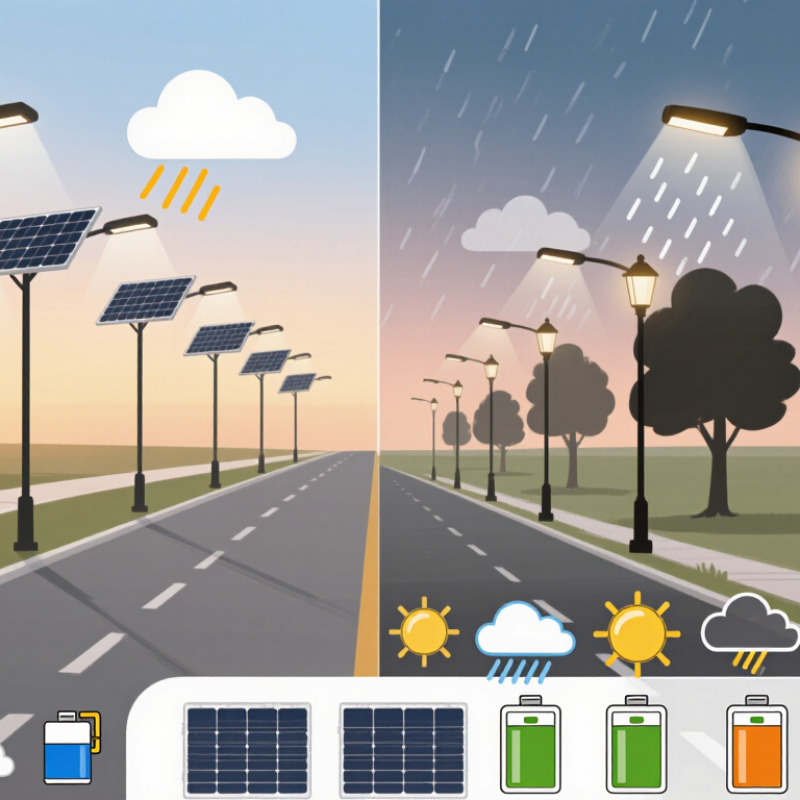
Choosing solar-powered street lights starts with observing the site, not just checking a map. Visit at different times of day and note shadows from trees, buildings, and utility poles. Shade shifts with seasons. A panel that receives strong summer sun may lose valuable charging hours in winter. Cloudy days matter, too, so consider local weather patterns and how many nights of backup power the system may need.
Climate affects both performance and maintenance. High temperatures can shorten battery life, while freezing conditions may reduce charging or battery output. Dust, salt spray, heavy rain, and snow can also affect panels and fixtures. Check whether the panel can be angled for your location and cleaned safely. Then assess the installation area: confirm the pole can support the equipment, and look for branches or signs that could block light. Estimate the required brightness and operating hours from actual nighttime use. These estimates can be imperfect; revisit them after installation.
Tips: Record sunlight at morning, noon, and late afternoon. Check the site again in winter if possible. Keep panels clear of shade, and leave safe access for cleaning and inspection. Small details count.
Compare Solar Panels, Batteries, and Light Specifications
Choose the solar panel by its winter output, not its peak-watt label. Compare local sunlight, panel angle, and nearby shade. A tree that barely shades the pole in summer may block useful winter sun. NREL’s review of photovoltaic systems found a median annual degradation rate of about 0.5%. That gradual loss matters over a long service life. Do not size a panel around its first-year output alone. (Jordan and Kurtz, NREL, 2013)
For batteries, compare usable watt-hours, not just the printed capacity. Check the specified discharge limit, operating temperature, and days of autonomy. DOE’s 2022 storage assessment uses about 85% round-trip efficiency as a lithium-ion benchmark for larger systems; a small streetlight battery may perform differently. Ask for test conditions. Cold nights and cloudy stretches can expose optimistic assumptions, and a tidy spreadsheet will not capture every site condition.
Match the light to the road. Review maintained illuminance, distribution, mounting height, and dimming settings—not lumens alone. A narrow beam can leave dark gaps between poles. Small details matter. Confirm that the quoted runtime includes the chosen brightness schedule and sensor behavior. Then compare the panel and battery as a system: a powerful lamp paired with undersized storage may dim before dawn. Check the fine print.
Evaluate Total Cost and Local Standards
A solar street light’s purchase price tells only part of its cost. Compare the full installed system: pole, panel, battery, controller, foundations, labor, and future servicing. Include battery replacement and cleaning, especially where dust, snow, or long cloudy periods reduce output. Then estimate the grid electricity actually avoided. The U.S. Energy Information Administration reported an average commercial electricity price of 12.77 cents per kilowatt-hour in 2023. At that rate, a 100-watt light running 12 hours nightly uses about 438 kilowatt-hours yearly, worth roughly $56 before losses or maintenance. That estimate is imperfect. Local tariffs and operating hours can change the result sharply.
Check the road authority’s requirements before choosing brightness or pole spacing. IES RP-8-22 provides roadway-lighting recommendations for visibility and uniformity, but local agencies may set their own criteria. Ask for a photometric plan showing how light falls across the pavement, not just the fixture’s lumen rating. Also verify applicable electrical, structural, and product-safety requirements for the project location. A bright sample in a showroom proves little. On site, trees, nearby buildings, winter shade, and glare can undermine performance. Request battery autonomy calculations based on local weather, and compare the warranty with expected replacement costs. A cheaper system may look sensible on paper, then disappoint after its first cloudy season.